
Ray (optics)
Geometrical model of light propagation used in optical analysis.

C.Sarabalis · CC BY-SA 4.0
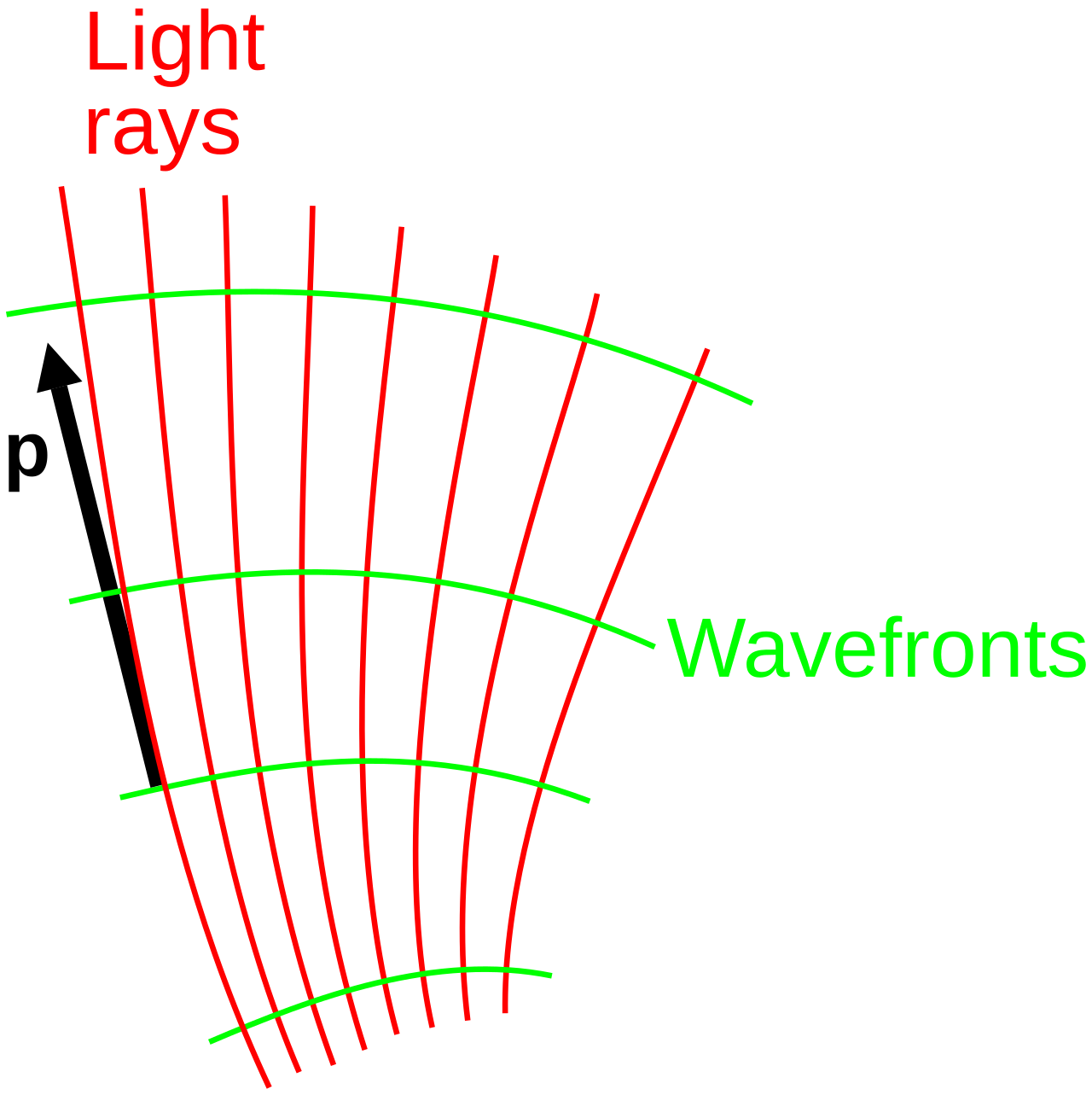
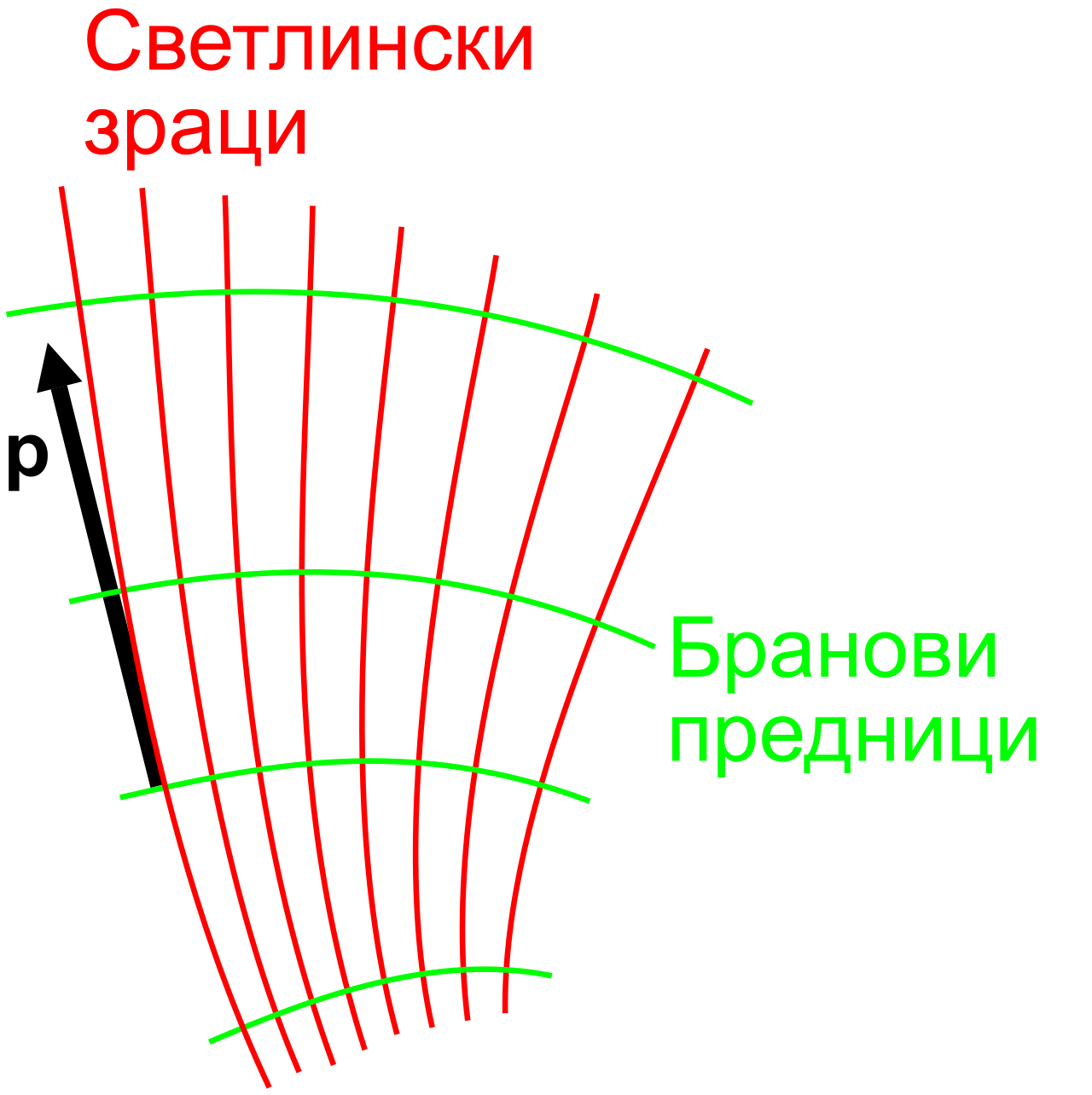
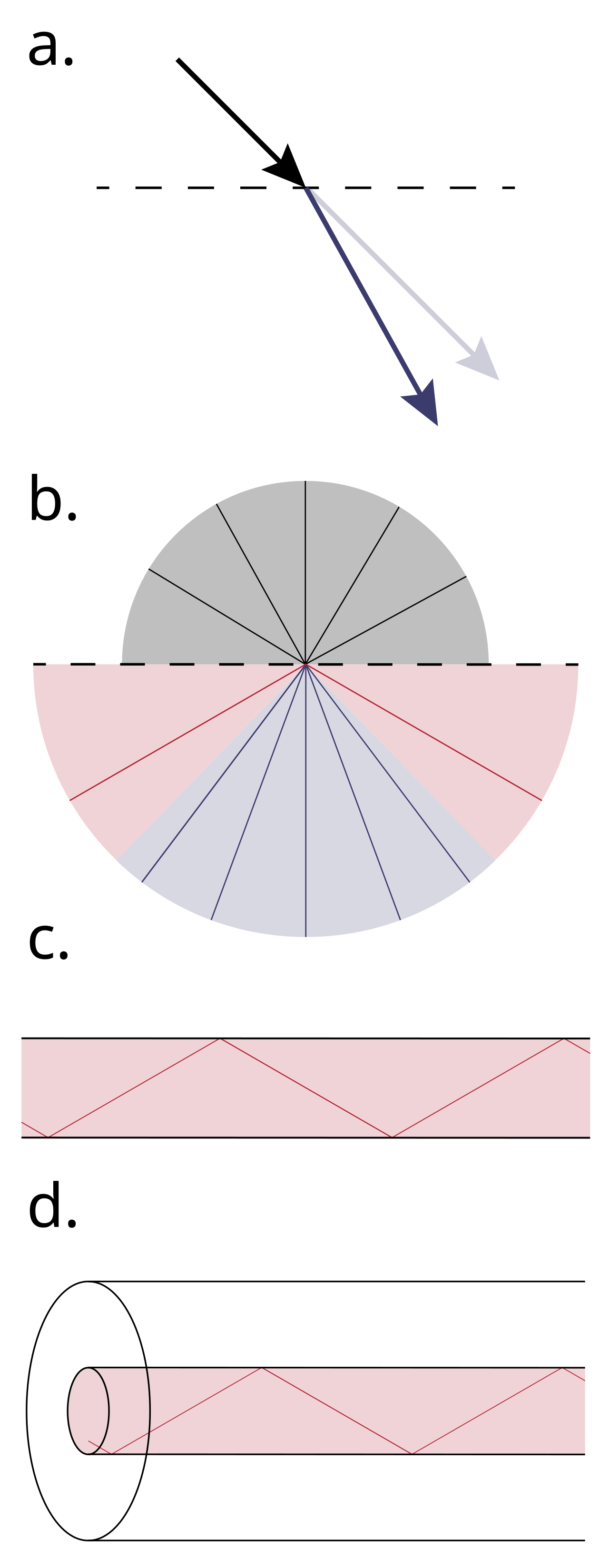
In optics, a ray is an idealized geometrical model of light or other electromagnetic radiation, obtained by choosing a curve that is perpendicular to the wavefronts of the actual light and that points in the direction of energy flow. Rays are used to model the propagation of light through an optical system, dividing the real light field into discrete rays that can be computationally propagated by ray tracing, allowing complex optical systems to be analyzed mathematically or simulated by computer.
- field
- Optics
- known_for
- Geometrical model of light propagation; basis of ray tracing
- related_concepts
- Wavefronts, Fermat's principle, Snell's law, Law of Reflection
Lore & Background
A light ray is defined as a line (straight or curved) that is perpendicular to the light's wavefronts, with its tangent collinear with the wave vector. In homogeneous media, rays are straight; they bend at the interface between two dissimilar media and may be curved in a medium where the refractive index changes. A slightly more rigorous definition follows from Fermat's principle, which states that the path taken between two points by a ray of light is the path that can be traversed in the least time. Special rays are used in optical modeling. An incident ray strikes a surface, with the angle between it and the normal being the angle of incidence. The reflected ray corresponds to light reflected by the surface, and the Law of Reflection states that for a specular surface, the angle of reflection equals the angle of incidence. The refracted or transmitted ray represents light transmitted through the surface, with its angle given by Snell's law. Conservation of energy requires that the power in the incident ray equals the sum of the power in the refracted ray, the reflected ray, and any absorbed power. If the material is birefringent, the refracted ray may split into ordinary and extraordinary rays. In optical systems, a meridional or tangential ray is confined to a plane that includes the optical axis. A skew or oblique ray does not propagate in a meridional plane. The marginal ray starts from an on-axis object point and touches the edge of the aperture stop, crossing the optical axis where a real image forms. The principal or chief ray starts at an off-axis object point and passes through the center of the aperture stop, defining image size. Paraxial rays make small angles to the optical axis and can be modeled using the paraxial approximation. In fiber optics, a meridional ray passes through the fiber axis, while a skew ray travels in a non-planar zig-zag path and never crosses the axis.
Reader's Guide
The concept of the ray is foundational to geometrical optics, enabling the analysis and design of optical systems from simple lenses to complex instruments. By treating light as discrete rays perpendicular to wavefronts, engineers and scientists can mathematically propagate rays through systems using ray tracing, which provides approximate solutions to Maxwell's equations valid when object dimensions are much greater than the light's wavelength. This approach allows even very complex optical systems to be analyzed mathematically or simulated by computer. Rays are essential for understanding image formation, as objects are treated as collections of independent point sources, each producing spherical wavefronts and corresponding outward rays. Special rays such as the marginal ray and chief ray define key system properties: the marginal ray determines pupil size and image location, while the chief ray defines image size. Together they characterize the Lagrange invariant, which describes the throughput or etendue of the optical system. However, ray optics does not describe phenomena such as diffraction, which require wave optics theory. Some wave phenomena like interference can be modeled in limited circumstances by adding phase to the ray model. Despite these limitations, the ray model remains a powerful and widely used tool in optical design, from consumer cameras to scientific instruments and fiber optic communications.
Did You Know?
- A light ray is a line (straight or curved) that is perpendicular to the light's wavefronts.
- The path taken between two points by a ray of light is the path that can be traversed in the least time, according to Fermat's principle.
- The marginal ray in an optical system starts from an on-axis object point and touches the edge of the system's aperture stop.
- In a birefringent material, the refracted ray may split into ordinary and extraordinary rays.
Gallery

Frequently Asked Questions
Who is Ray (optics)?
A ray in optics is a simplified geometric line that represents how light travels through space, drawn perpendicular to the actual wavefronts and pointing along the direction energy flows. It is not a physical object but a mathematical tool that lets us track light's path through lenses, mirrors, and other optical components.
What are Ray (optics)'s powers/role?
A ray's primary role is to break a continuous light field into individual, trackable paths so that engineers and physicists can compute how light bends, reflects, or focuses through an optical system. This is the foundation of ray tracing, the computational method used to simulate complex lens assemblies and optical instruments.
How does Ray (optics)'s story end?
A ray's trajectory concludes when it exits an optical system or is absorbed, but along the way it obeys Snell's law at refracting surfaces and the law of reflection at mirrors. Its overall path is ultimately governed by Fermat's principle, which states that light takes the route of least time between two points.
Why is Ray (optics) important?
Without the ray model, analyzing multi-element optical systems like camera lenses, telescopes, or fiber-optic networks would be far more computationally demanding. It provides a tractable framework that captures the essential behavior of light propagation while sidestepping the full complexity of Maxwell's equations.
Who are Ray (optics)'s closest allies?
The ray model is tightly linked to wavefronts (the surfaces it stays perpendicular to), Fermat's principle (the variational rule that determines its path), Snell's law (which governs its refraction at interfaces), and the law of reflection (which controls its bounce off mirrors). Together these concepts form the core toolkit of geometrical optics.
More in Optics And Photonics 25-34
Elsewhere in the Optics And Photonics universe
Spotted an error? Know more?
This is a living reference — every entry is fact-audited, and reader corrections feed straight into our audit queue. Suggest an edit · See this site's audit record