
Planckian locus
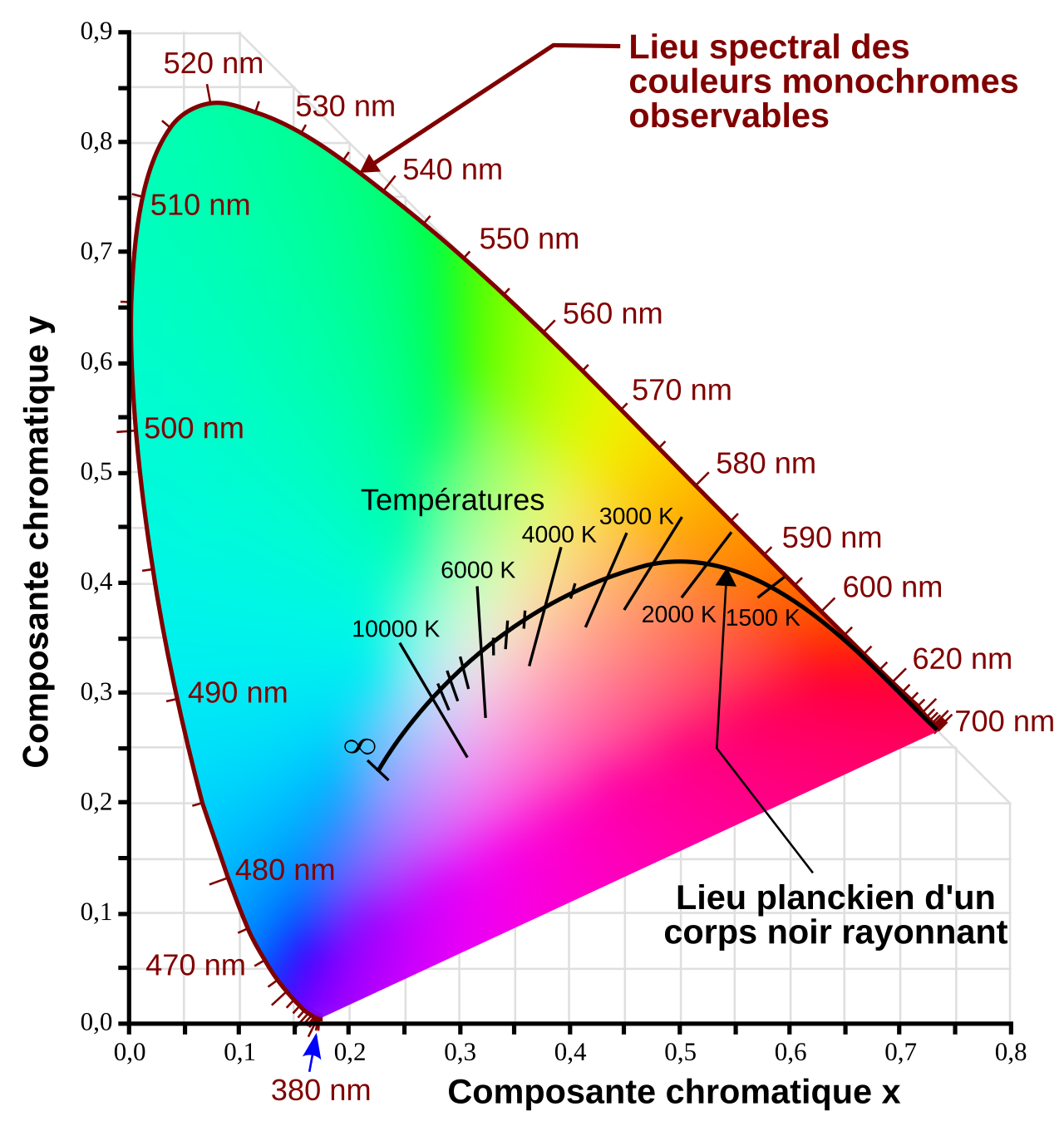
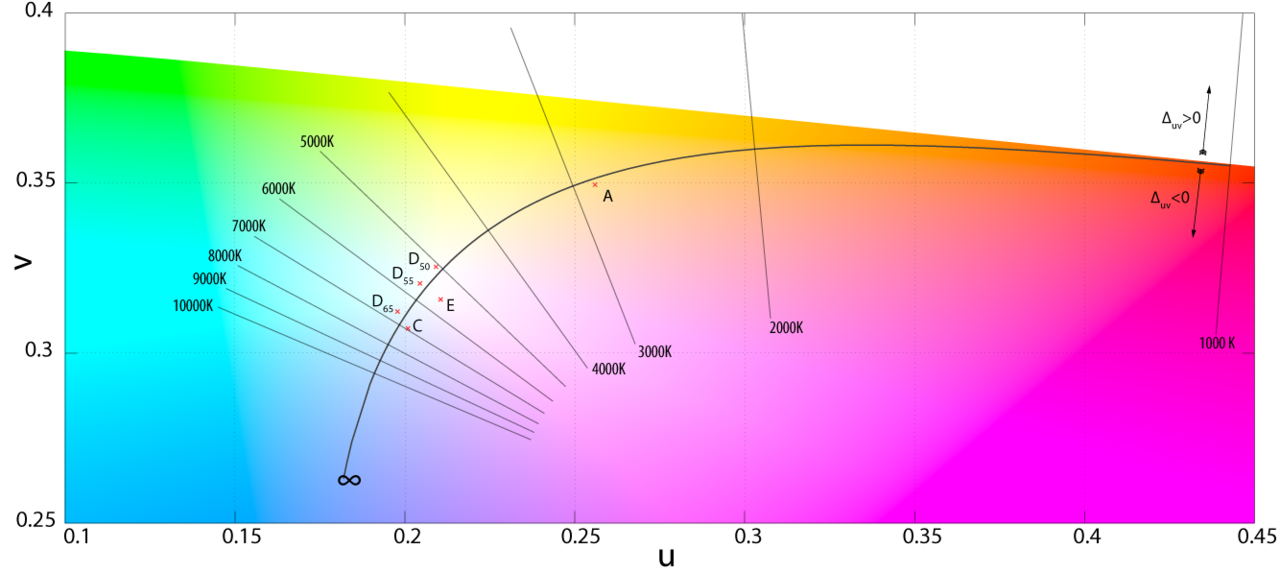
Path of black body color as temperature changes in chromaticity space.

File:CIE1931xyY Blank-fr.svg : * File:CIE1931xy blank.svg : BenRG derivative wor · CC BY-SA 3.0
The Planckian locus, also known as the black body locus, is the path that the color of an incandescent black body takes in a chromaticity space as its temperature changes. It is a fundamental concept in physics and color science, describing how the perceived color of a perfect radiator shifts from deep red through orange, yellowish, white, and finally bluish white at very high temperatures.
- field
- Physics and color science
- defined_in
- CIE XYZ color space
- key_equation
- Planck's law
- coordinates_used
- X, Y, Z (CIE coordinates) and x, y (chromaticity coordinates)
- temperature_range
- From low temperatures (deep red) to very high temperatures (bluish white)
Lore & Background
The Planckian locus is derived by substituting the black body spectral radiant exitance, given by Planck's law, into the integrals that define the CIE XYZ color space coordinates. The spectral radiant exitance M(λ,T) depends on wavelength λ and temperature T, with constants c1 and c2 derived from the Planck constant, speed of light, and Boltzmann constant. The resulting X_T, Y_T, and Z_T values are then normalized to produce the chromaticity coordinates x_T and y_T, which trace the locus on the standard chromaticity diagram.
Reader's Guide
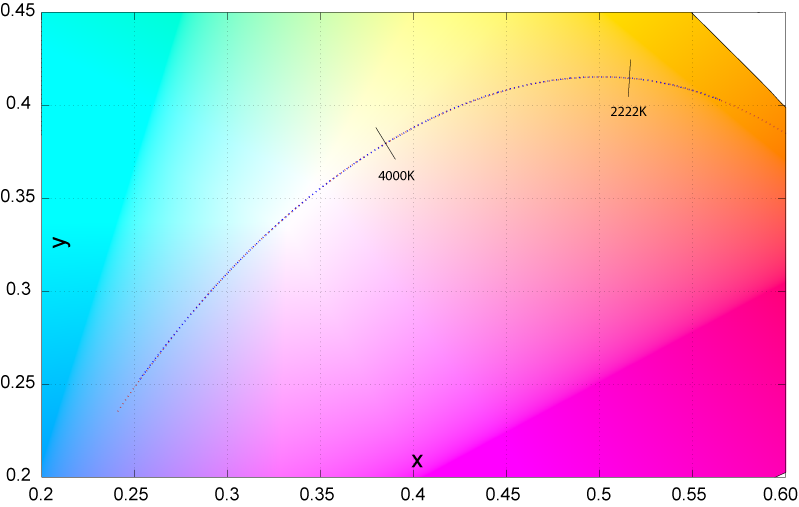
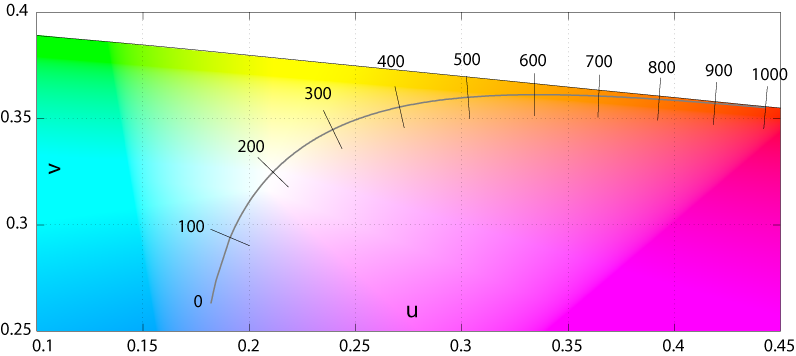
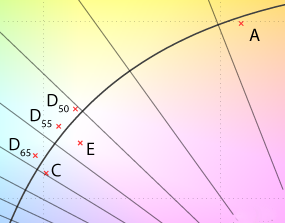
The Planckian locus is significant because it provides a standard reference for the color of thermal radiators, such as incandescent light sources, across a range of temperatures. In color science, it is used to define correlated color temperature (CCT) and to characterize the color rendering of light sources. The locus is often depicted on the CIE xy chromaticity diagram, where it forms a curve from deep red to bluish white. Approximations, such as cubic spline functions of reciprocal temperature (mired scale), allow for faster computation of the locus coordinates. The concept is essential for understanding how the human visual system perceives color changes in heated objects and for designing lighting that mimics natural daylight.
Did You Know?
- The Planckian locus goes from deep red at low temperatures through orange, yellowish, white, and finally bluish white at very high temperatures.
- The locus is determined by substituting the black body spectral radiant exitance from Planck's law into the CIE XYZ color space integrals.
- The chromaticity coordinates x_T and y_T are calculated by normalizing X_T, Y_T, and Z_T so that x_T = X_T / (X_T + Y_T + Z_T) and y_T = Y_T / (X_T + Y_T + Z_T).
- Approximations of the locus often use functions of the reciprocal temperature (mired scale) for faster computation, such as a cubic spline by Kim et al.
Gallery

Frequently Asked Questions
What is the Planckian locus?
It is the curved track that traces how the apparent color of an ideal black-body radiator moves across a chromaticity diagram as you progressively heat it. The path begins in the deep-red region and sweeps through orange, yellow, neutral white, and into the blue-white zone at extreme temperatures.
In which color space is the Planckian locus plotted?
It is drawn in the CIE XYZ color space, typically projected onto the two-dimensional x, y chromaticity plane. Those normalized coordinates are what let you see the locus as a smooth curve rather than a three-dimensional surface.
What physical law generates the Planckian locus?
The locus is a direct consequence of Planck's law of black-body radiation, which specifies the spectral power distribution at every wavelength for a given temperature. Integrating that spectrum against the CIE color-matching functions yields the X, Y, Z values that trace out the curve.
How does the perceived color shift along the Planckian locus?
At low temperatures the point sits in the red part of the diagram, and as temperature climbs it drifts through orange and yellow toward a neutral white. Push the temperature high enough and the point continues into the bluish-white region, completing the familiar hotter-looks-bluer progression.
Why do color scientists and lighting engineers care about the Planckian locus?
It serves as a reference benchmark for judging whether a light source's color appears natural or incandescent. Many lighting standards and color-temperature ratings are anchored to points along this curve, making it a cornerstone of both physics and practical color science.
More in Optics And Photonics 25-34
Elsewhere in the Optics And Photonics universe
Spotted an error? Know more?
This is a living reference — every entry is fact-audited, and reader corrections feed straight into our audit queue. Suggest an edit · See this site's audit record