Snell's law
Law describing refraction of light between two isotropic media.
Snell's law, also called the Snell–Descartes law or the law of refraction, is a formula that relates the angles at which light or other waves enter and exit a boundary between two different isotropic materials, like water, glass, or air. In optics, it is used in ray tracing to calculate transmission or refraction angles, and in experimental work to determine a material's refractive index. The law also holds for metamaterials, where light can be bent backward at a negative refraction angle due to a negative refractive index.
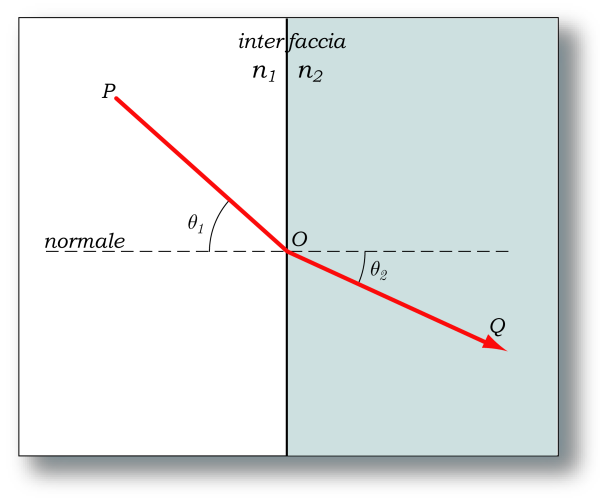
The law states that for any two given media, the ratio of the sine of the angle of incidence (θ₁) to the sine of the angle of refraction (θ₂) equals the refractive index of the second medium relative to the first (n₂,₁). This ratio is also equal to the ratio of the two media's refractive indices (n₂/n₁) and to the ratio of the phase velocities in the two media (v₁/v₂). Mathematically: sinθ₁ / sinθ₂ = n₂,₁ = n₂/n₁ = v₁/v₂. The law follows from Fermat's principle of least time, which itself stems from the wave nature of light.
Historically, Ptolemy in Alexandria found a relationship for refraction angles, but it was inaccurate except for small angles. He believed he had an accurate empirical law, partly because he adjusted his data to fit his theory, an example of confirmation bias. The law is named after Snell, but it was first discovered by the Persian scientist Ibn Sahl at the Baghdad court in 984. In his manuscript *On Burning Mirrors and Lenses*, Sahl used the law to design lens shapes that focus light without geometric aberration. Ibn al-Haytham, in his *Book of Optics* (1021), came close to rediscovering it but did not take the final step. Thomas Harriot rediscovered it in 1602 but did not publish his results, though he corresponded with Kepler on the topic. In 1621, Dutch astronomer Willebrord Snellius (Snell) derived a mathematically equivalent form, which remained unpublished during his lifetime. René Descartes independently derived the law in 1637 using heuristic momentum conservation arguments with sines in his essay *La Dioptrique*, applying it to various optical problems. Rejecting Descartes' solution, Pierre de Fermat reached the same result using his principle of least time. Descartes assumed light's speed was infinite but also, in his derivation, assumed it was faster in denser media. Fermat assumed the opposite—that light's speed is finite and slower in denser media—and his derivation relied on his invention of adequality, a mathematical method equivalent to differential calculus for finding maxima, minima, and tangents.
- field
- Optics, Physics
- known_for
- Law of refraction (Snell's law)
Lore & Background
In the manuscript On Burning Mirrors and Lenses, Sahl used the law to derive lens shapes that focus light with no geometric aberration. Rejecting Descartes' solution, Pierre de Fermat arrived at the same solution based solely on his principle of least time. Descartes assumed the speed of light was infinite, yet in his derivation he also assumed the denser the medium, the greater the speed of light. Fermat supported the opposing assumptions, i.e., the speed of light is finite, and his derivation depended upon the speed of light being slower in a denser medium.
Reader's Guide
Snell's law is fundamental to optics, used in ray tracing to compute angles of transmission or refraction, and in experimental optics to find the refractive index of a material. The law is also satisfied in meta-materials, which allow light to be bent backward at a negative angle of refraction with a negative refractive index. The law follows from Fermat's principle of least time, which in turn follows from the propagation of light as waves. With the development of modern optical and electromagnetic theory, Snell's law was redefined. The law is generally true only for isotropic or specular media; in anisotropic media such as some crystals, birefringence may split the refracted ray into two rays, the ordinary ray which follows Snell's law, and the extraordinary ray which may not be co-planar with the incident ray.
Did You Know?
- Ptolemy had found a relationship regarding refraction angles, but it was inaccurate for angles that were not small, and he slightly altered his data to fit theory.
- Both Fermat and Huygens accused Descartes of having copied Snell, though Dijksterhuis states this charge is undeserved.
The Mathematical Core and Its Equivalences
At its heart, Snell's law encodes a single elegant proportionality. When a wavefront crosses the boundary between two isotropic media—air into water, glass into vacuum, or any such pair—the sine of the incoming angle divided by the sine of the outgoing angle yields a fixed number for that particular pair of materials. That number is the relative refractive index of the second medium with respect to the first. Equally, it equals the quotient of the two media's absolute refractive indices, and it equals the ratio of their phase velocities. The law is not limited to ordinary materials. It also holds in meta-materials, engineered structures that permit light to refract at a negative angle, bending in what appears to be the wrong direction because the effective refractive index is negative. In every case, the same sine-ratio relationship governs the geometry of the bend.
Practical Roles in Ray Tracing and Metrology
In the workshop and the laboratory, Snell's law serves two primary roles. In ray tracing—the computational technique for predicting how light propagates through an optical system—the law provides the exact angle at which a transmitted ray emerges after striking an interface, making it indispensable for designing lenses and prisms. In experimental optics, the relationship works in reverse: by measuring the angles of incidence and refraction at a known boundary, a researcher can back-calculate the refractive index of an unknown material, turning the law into a straightforward metrological tool. The law's reach extends beyond conventional glass and water. In meta-materials, artificial composites engineered to exhibit a negative refractive index, the same mathematical relationship is satisfied, but the resulting refraction angle is negative, causing the transmitted wave to bend to the same side of the normal as the incident wave. This backward bending opens possibilities that ordinary materials cannot provide.
A Tangled History of Discovery
The path to the law's modern name is far more convoluted than a single eponym suggests. Ptolemy, working in Alexandria, recorded an empirical relationship between refraction angles, but his formula broke down for anything beyond small angles, and he reportedly nudged his data to fit his preferred theory.
Theoretical Foundations and Broader Geometry
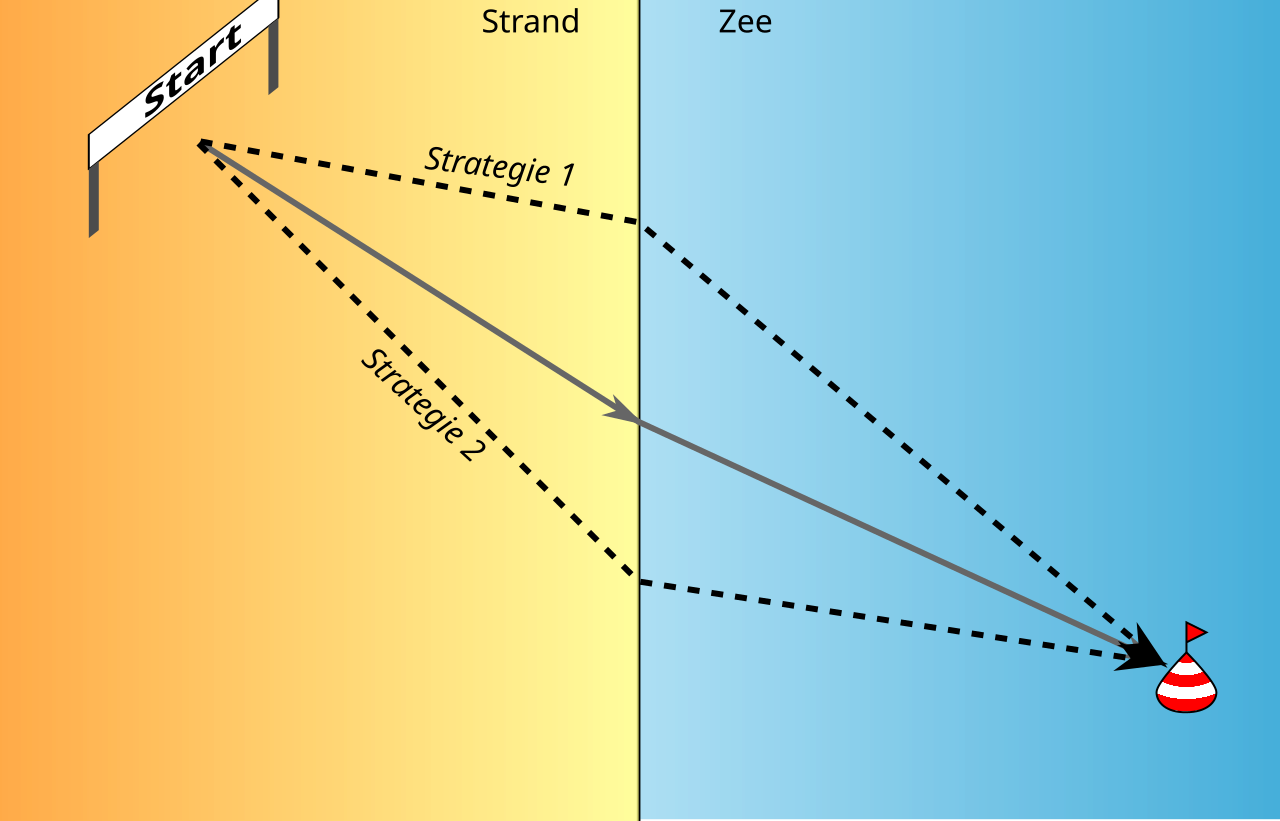
Snell's law is not an isolated empirical rule; it flows directly from Fermat's principle of least time, which itself rests on the wave nature of light's propagation. This connection became the flashpoint of a famous intellectual dispute. Descartes derived the law using heuristic momentum-conservation arguments and assumed light's speed was infinite, yet paradoxically also assumed it traveled faster in denser media. Fermat rejected both assumptions, insisting the speed was finite and slower in denser media, and he proved the law using his own invention of adequality, a procedure equivalent to differential calculus for finding extrema and tangents. The law also surfaced in Descartes' Geometry, where he tackled a problem originally posed by Apollonius and Pappus: given a set of lines and a point on each, find the locus of points whose distances to those points satisfy a prescribed product condition. For four lines, Pappus had shown the loci were conics, but Descartes extended the analysis to higher numbers of lines and obtained cubic and higher-degree curves. He demonstrated that these cubics arise naturally from Snell's law in optics, linking the refraction formula to deep geometric structure.
Gallery

Frequently Asked Questions
Who is Snell's law?
Snell's law is the foundational formula in optics that links the angle at which a wave strikes a boundary to the angle at which it bends as it enters a second medium. It is also called the Snell–Descartes law or simply the law of refraction.
What are Snell's law's powers/role?
It lets you calculate exactly how light or any other wave changes direction when crossing between two isotropic materials such as air, water, or glass. The core relationship ties the sines of the incidence and refraction angles to the ratio of the two media's refractive indices.
How does Snell's law's story end?
When the calculated refraction angle would exceed 90 degrees, the wave can no longer pass into the second medium and is instead totally reflected back — a phenomenon known as total internal reflection. This marks the natural boundary of the law's predictive range and is the principle behind fiber-optic cables.
Why is Snell's law important?
It underpins virtually every lens design, prism calculation, and fiber-optic system used in modern photonics. Without this single ratio, engineers could not predict how light bends through the glass in cameras, telescopes, or the internet's backbone.
More in Optics And Photonics 1-24
Spotted an error? Know more?
This is a living reference — every entry is fact-audited, and reader corrections feed straight into our audit queue. Suggest an edit · See this site's audit record