
Rayleigh scattering
Rayleigh scattering explains why the sky is blue.
Rayleigh scattering (pronounced RAY-lee) occurs when light or other electromagnetic radiation is deflected by particles that are much smaller than the radiation's wavelength. In conditions where the light's frequency is well below the scattering medium's resonance frequency (known as the normal dispersion regime), the amount of scattering is proportional to one divided by the wavelength raised to the fourth power. This means, for example, that blue light scatters far more than red light as it travels through air. The effect is named for the 19th-century British physicist Lord Rayleigh (John William Strutt).
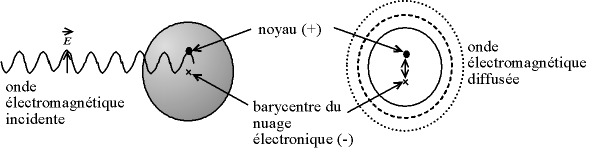
The scattering arises from the electric polarizability of the particles. An incoming light wave's oscillating electric field pushes and pulls on the charges inside a particle, making them vibrate at the same frequency. This turns the particle into a tiny radiating dipole, and the radiation it emits is what we perceive as scattered light. The particles involved can be individual atoms or molecules. Rayleigh scattering can happen when light passes through transparent solids and liquids, but it is most noticeable in gases.
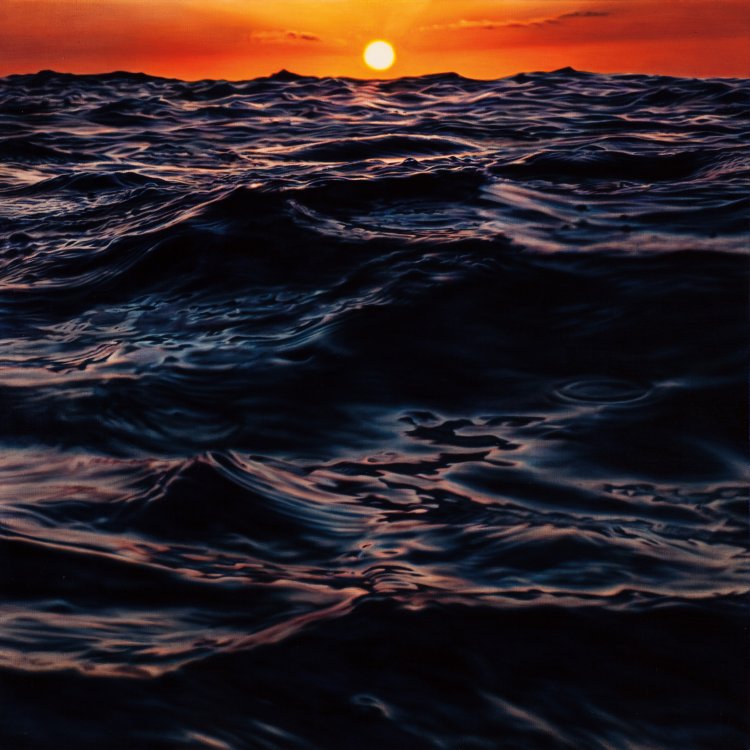
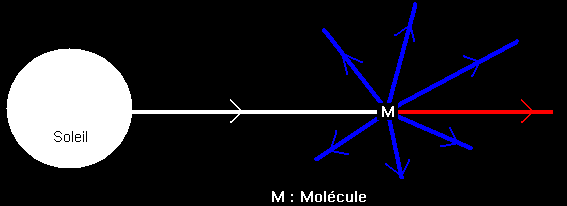
Sunlight undergoing Rayleigh scattering in Earth's atmosphere produces diffuse sky radiation. Because shorter blue wavelengths scatter more strongly, the diffuse sky appears blue during the day. At twilight, sunlight traveling along the horizon has lost much of its scattered blue light, giving the low Sun a yellowish to reddish hue.
When scattering particles are about the same size as, or larger than, the light's wavelength, the process is usually described by Mie theory, the discrete dipole approximation, or other computational methods. Rayleigh scattering specifically applies to particles that are small relative to the light's wavelength and are optically "soft"—meaning their refractive index is close to 1. For larger but still optically soft particles, anomalous diffraction theory is used.
**History** Around 1506–1510, Leonardo da Vinci suggested that sunlight scattering off tiny particles in the atmosphere caused the sky's blue color; analysis of his paintings indicates he recognized how particle size influences light scattering. In 1869, John Tyndall, while checking for contaminants in purified air used for infrared experiments, found that bright light scattering off nanoscopic particles had a faint blue tint. He proposed this explained the sky's blueness but could not account for why blue light was favored, nor could atmospheric dust alone explain the sky's vivid color. In 1871, Lord Rayleigh published two papers on the color and polarization of skylight, quantifying Tyndall's effect in water droplets in terms of particle volumes and refractive indices. In 1881, using James Clerk Maxwell's 1865 proof that light is electromagnetic, Rayleigh showed his equations followed from electromagnetism. In 1899, he demonstrated that the same equations applied to individual molecules, replacing terms for particle volume and refractive index with terms for molecular polarizability. This 1899 paper established the basic scientific model for why the sky is blue.
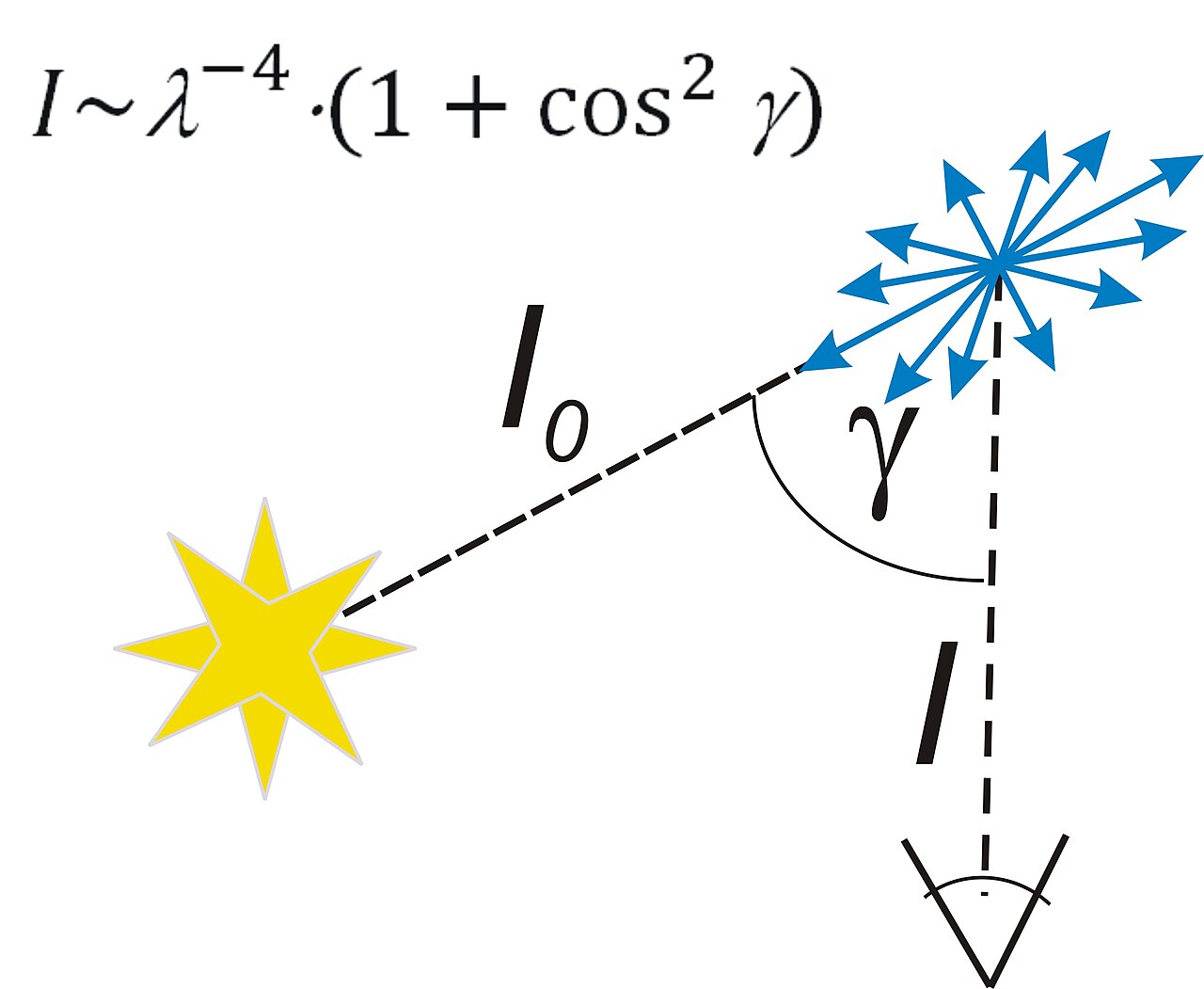
**Small size parameter approximation** The size of a scattering particle is often described by the ratio x = 2πr / λ, where r is the particle's radius, λ is the light's wavelength, and x is a dimensionless parameter. Objects with x much greater than 1 behave like geometric shapes, scattering light based on their projected area. At intermediate values (x around 1), Mie scattering occurs, with interference effects from phase variations across the object's surface. Rayleigh scattering applies when the particle is very small (x much less than 1, meaning particle size less than one-tenth the wavelength), so the entire surface re-radiates in the same phase. Because the particles are randomly positioned, the scattered light arriving at a given point has a random mix of phases; it is incoherent, and the total intensity is simply the sum of the squares of the amplitudes from each particle. This intensity is therefore proportional to the inverse fourth power of the wavelength and the sixth power of the particle's size. The wavelength dependence is characteristic of dipole scattering, while the volume dependence applies to any scattering mechanism. Specifically, the intensity I_s of light scattered by a single small sphere of radius r and refractive index n, from an unpolarized beam of wavelength λ and intensity I_0, is given by I_s = I_0 * (1 + cos²θ) / (2R²) * (2π/λ)⁴ * ((n² - 1) / (n² + 2))² * r⁶.
- field
- Physics
- nationality
- British
- known_for
- Rayleigh scattering, explaining the color of the sky
Lore & Background
It was this paper that established the basic scientific model for the color of the sky. Rayleigh scattering results from the electric polarizability of the particles. The oscillating electric field of a light wave acts on the charges within a particle, causing them to move at the same frequency. The particle becomes a small radiating dipole whose radiation we see as scattered light. The particles may be individual atoms or molecules; it can occur when light travels through transparent solids and liquids, but is most prominently seen in gases. Rayleigh scattering of sunlight in Earth's atmosphere causes diffuse sky radiation. Since blue light wavelengths scatter more, the diffuse sky seen in daytime is blue. At twilight the sunlight on the horizon is missing the scattered blue light wavelengths giving a yellowish to reddish hue to the low Sun.
Reader's Guide
Rayleigh scattering is fundamental to understanding the color of the sky and atmospheric optics. The phenomenon occurs when light interacts with particles much smaller than its wavelength, such as individual molecules in air. The intensity of scattered light is inversely proportional to the fourth power of the wavelength, meaning shorter wavelengths like blue are scattered much more than longer wavelengths like red. This explains why the daytime sky appears blue and why sunsets appear reddish, as the blue light has been scattered away from the direct path. The mathematical description involves the particle's radius, refractive index, and the wavelength of light, with the scattering cross-section proportional to the sixth power of the particle size. Rayleigh scattering applies to particles that are small with respect to wavelengths of light and that are optically 'soft' (refractive index close to 1). For larger particles, Mie theory or other computational techniques are used. The work of Lord Rayleigh built upon earlier observations by Leonardo da Vinci and John Tyndall, but Rayleigh provided the quantitative electromagnetic theory that remains the standard model for molecular scattering.
The Dipole Mechanism at the Particle Scale
Rayleigh scattering originates in the electric polarizability of extremely small particles. When the oscillating electric field of an incoming light wave strikes an atom or molecule, it drives the internal charges to vibrate at the same frequency. The particle thereby transforms into a miniature radiating dipole, and the radiation it emits is what we observe as scattered light. This process is most conspicuous in gases, though it also takes place in transparent solids and liquids. Two constraints are essential: the particle must be smaller than one-tenth of the incident wavelength, and it must be optically soft, meaning its refractive index sits close to unity. Under these conditions the entire surface of the particle re-radiates in a single coherent phase. Because individual particles are randomly distributed, the scattered waves reach any given observation point carrying a jumble of random phases, rendering the light incoherent. The total intensity is therefore the straightforward sum of each particle's squared amplitude. This summation produces the hallmark inverse-fourth-power dependence on wavelength and the sixth-power dependence on particle radius that define the Rayleigh regime.
From Da Vinci's Sketches to Maxwell's Equations
The intellectual path toward a rigorous explanation of the sky's color stretched across nearly four centuries. He linked this to the sky's color but could not explain why blue was favored over red, nor could dust account for the sky's vivid intensity. That final paper cemented the foundational scientific account of why the sky is blue.
Blue Skies and Red Horizons
The everyday signature of Rayleigh scattering is the color palette of Earth's atmosphere. Because scattering intensity scales with the inverse fourth power of wavelength, short blue wavelengths are deflected far more aggressively than long red ones as sunlight threads through the air. This preferential scattering of blue produces the diffuse glow that fills the daytime sky when we look away from the Sun. At twilight the geometry shifts dramatically: the Sun's rays traverse a far thicker atmospheric slab to reach the horizon, and along that extended path the blue wavelengths are scattered out of the direct beam. What survives to our eyes is a yellowish-to-reddish tint on the low Sun. The same physics generates diffuse sky radiation, the ambient scattered light that brightens shadowed areas and illuminates cloud undersides. The effect is strongest in gaseous media like air, where individual molecules satisfy the small-particle condition, and it operates in the normal dispersion regime—light frequencies well below the resonance frequency of the scattering medium.
The Size Parameter and Its Neighboring Theories
Rayleigh scattering is confined to a narrow window defined by the dimensionless size parameter x, computed as 2πr over the wavelength λ, with r representing the particle radius. When x greatly exceeds one, objects scatter light as geometric shapes according to their projected area. At intermediate values hovering around one, Mie scattering governs, and interference effects emerge from phase variations across the object's surface. Rayleigh scattering applies strictly in the limit where x is much less than one—particle radius below one-tenth of the wavelength—and the particle is optically soft with a refractive index near unity. In this regime the whole surface re-radiates in phase, and the scattered intensity from a single small sphere depends on the incident beam intensity, the scattering angle through a (1 + cos²θ) angular factor, the inverse fourth power of wavelength, the sixth power of radius, and a refractive-index term. Averaging over all angles yields the Rayleigh scattering cross-section. Particles that are optically soft but larger than the Rayleigh threshold fall under anomalous diffraction theory, while particles comparable to or larger than the wavelength demand Mie theory or the discrete dipole approximation.
Gallery


Frequently Asked Questions
Who is Rayleigh scattering?
Rayleigh scattering is a physics phenomenon in which light is deflected by particles far smaller than its own wavelength. It takes its name from Lord Rayleigh, the 19th-century British physicist John William Strutt, who first described the effect.
What are Rayleigh scattering's powers/role?
Its signature ability is deflecting shorter wavelengths far more strongly than longer ones, following an inverse fourth-power relationship with wavelength. This is precisely why the daytime sky looks blue and sunsets glow red.
How does Rayleigh scattering's story end?
The effect loses its clean, predictable behavior once the scattering particles grow to a size comparable to the incoming wavelength, at which point Mie scattering takes over. It also becomes less straightforward when the light frequency approaches the material's resonance frequency.
Why is Rayleigh scattering important?
It provides the physical explanation for the blue color of the sky and the warm hues of sunrise and sunset. Beyond that, it underpins atmospheric remote sensing, lidar technology, and loss calculations in fiber-optic communication.
Who is Rayleigh scattering's rival?
Mie scattering is its closest counterpart, handling the regime where particles are roughly the same size as the wavelength of light. Together the two effects cover the full landscape of elastic light scattering in the atmosphere.
More in Optics And Photonics 1-24
Spotted an error? Know more?
This is a living reference — every entry is fact-audited, and reader corrections feed straight into our audit queue. Suggest an edit · See this site's audit record